
Home › Betting Strategy
By The Guv'nor · Last updated October 2026
The best horse racing betting strategy is not a secret system. It is ten boring rules that a stats geek follows every single day: bet the price, not the horse; judge yourself on profit; stake in points; expect losing runs; take early prices with Best Odds Guaranteed; keep records. Below is each rule with the number behind it.
Look, I was a Quantitative Researcher at a Tier 1 investment bank in the UK, and I now use those skills on racing, profitably enough that most of your favourite bookies won't take a bet from me. No magic angle, just the dull stuff done properly.
| Rule | The number behind it | Full maths on |
|---|---|---|
| 1. Profit beats strike rate | BSP favourites won 35.0% of 12,991 races yet lost 1.6% at BSP before commission | How often favourites win |
| 2. Price beats opinion | At BSP, every price band from 1.01 to 100 returned between -2.7% and +6.2% before commission | Value betting |
| 3. Know your edge | At 4/1 you need to win 20% of the time just to break even, and more than that to profit | Odds explained |
| 4. Know your sample size | After 100 bets, 1 in 4 losing punters is showing a profit | The table below |
| 5. Stake in points | 1pt = £5 on a £100 bank is my own example | What 1pt means |
| 6. Survive the losing runs | At a 25% strike rate, a run of 15 losers turns up in 57% of 250-bet stretches | Staking plans |
| 7. Take early prices with BOG | 74.0% of fancied runners (N 6,696) shortened from the morning price; 77.7% of big outsiders (N 45,615) drifted | SP and BOG |
| 8. Only put value in multiples | Singles returning 90p in the pound make a Lucky 15 return about 80p | Lucky 15 explained |
| 9. Keep records | A genuine +10% punter at 4/1 needs around 1,000 bets to be in profit 93% of the time | The table below |
| 10. Specialise | BSP favourites won 29.8% of handicaps (N 8,333) but 44.4% of non-handicaps (N 4,658) | Favourite stats |
Rules 1-2: Profit beats strike rate, and price beats opinion
Rule 1: Judge yourself on profit, not on how often you win
Anyone can talk about high win rates when they tip odds-on horses all day. But what are they actually winning profit wise?
A worked example in points. Stick 2pts on a 1/2 shot and it wins: you're up 1pt. Stick 1pt each-way (2pts in total) on a 12/1 outsider at a fifth the odds and it only places: the place half pays 1pt x (12/5 + 1) = 3.4pts back, so you're up 1.4pts even though the horse got beat. That's why I like outsiders and each-way value.
The data says the same thing. Over the 12 months to 30 September 2026 the Betfair SP favourite won 35.0% of 12,991 UK and Irish races, and backing every one of them at BSP still lost 1.6% of your stakes before commission. Winning more than a third of the time and still going backwards. The full breakdown is on how often favourites win.
Rule 2: The price is the whole bet
Every price is a probability in disguise. 4/1 (5.0 in decimal) means the market gives the horse a 1 in 5 chance, or 20%. If you reckon it's really a 25% shot, it's a bet. If you reckon it's 15%, it's not, however much you like the horse. That's value: not "will it win?" but "is the price bigger than its chance?"
The market is tougher to beat than most people think. Across 104,701 runners priced from 1.01 to 100 at Betfair SP in the 12 months to 30 September 2026, every one of the seven price bands I tested returned between -2.7% and +6.2% before commission. So the final exchange price is usually close to a horse's real chance. Only the 100-plus rags looked poor: -13.6% across 14,640 runners, but from just 61 winners, so treat that one with care. My full routine for spotting overpriced horses is on value betting in horse racing.
Rules 3-4: Know your edge and your sample size
Rule 3: Be able to say why the price is wrong
An edge is something the market hasn't fully priced in. If you can't explain in one sentence why a horse is bigger than it should be, you don't have an edge, you've got a feeling.
Mine come from a few places. One is a system that picks out horses that have won or come close off a higher weight or mark than they're running off today. Another is stable information from the trainers of horses I own, and market moves I'd call smart money. Each of those is a reason the price might be wrong. "It looked well in the paddock last time" usually isn't.
And know the bar you have to clear: at 4/1 you need to win one race in five just to break even, and more than that to make a profit. Horse racing odds explained has the full ladder of prices and the chance each implies.
Rule 4: Don't trust a small sample, good or bad
This is the one most punters (and plenty of tipsters) get wrong. A few weeks of results tell you almost nothing. To show how little, I worked out the exact odds for two punters who only bet at 4/1, level stakes:
- The good punter wins 22% of the time. That's a genuine +10% edge.
- The mug punter wins 18% of the time. That's -10%: no edge, just paying the bookie's margin.
| Bets placed | Good punter (+10%) in profit | Mug punter (-10%) in profit |
|---|---|---|
| 50 | 55.5% | 28.1% |
| 100 | 63.4% | 25.3% |
| 250 | 75.2% | 18.2% |
| 500 | 84.8% | 11.2% |
| 1,000 | 93.3% | 4.7% |
| 2,000 | 98.4% | 1.0% |
Read that again. After 100 bets, one mug punter in four is in profit and probably telling everyone about it, while more than a third of genuinely good punters are level or behind. Even after 500 bets, about 15% of good punters still aren't showing a profit.
So before you look at anyone's profit, ask how many bets it covers. More on that in are horse racing tipsters worth it and horse racing betting systems that work.
Rules 5-6: Stake in points and survive the losing runs
Rule 5: Divide your bank into points and stick to them
If you don't follow strict staking you will likely lose, even with good bets. Divide your betting bank into points. My example is 1pt = £5 on a £100 bank, and every bet gets a set number of points.
What you can't do is wake up, fancy one a bit more because you've got a feeling, and stick your whole balance on it. Don't chase and don't go all in. Points, each-way points and how big a point should be are all on what does 1pt mean in betting.
Rule 6: Expect long losing runs, because they will come
Understanding that losers are a thing is the key to being a winner longer term. The maths is brutal if you've never seen it. At a 25% strike rate, there's a 57% chance of at least one run of 15 losers in a row somewhere in 250 bets. At a 20% strike rate over 500 bets, it's 98%.
Now put that in points. Fifteen losers at 1pt each is 15pts gone, which is 75% of a bank where a point is 5% of the pot. Size your points for the run you'll actually get. If you want a smoother ride, use a bigger bank. Level stakes, percentage staking and Kelly are tested on staking plans for horse racing.
Rule 7: Take early prices, and use BOG where you can
BOG stands for Best Odds Guaranteed. You take a price early, and if the starting price (SP) ends up bigger, the bookie pays you at the SP instead. If the SP is shorter, you keep your price. Terms vary by bookmaker, so check their rules.
It matters because the market tends to move one way. In Betfair's published price files for the 12 months to 30 September 2026, 74.0% of fancied runners (BSP under 3.0, N = 6,696) were shorter at the off than their morning price, while 77.7% of big outsiders (BSP 21.0 or bigger, N = 45,615) drifted. The "morning price" here is Betfair's weighted average of bets placed before 11am GMT, not a bookmaker's early price.
One honest caveat: those runners are grouped by their final BSP, which you only know after the off, so this is hindsight. It shows which way prices tend to move, not a system you can bet blind.
So take the early price on horses you expect to be backed, let BOG protect you on drifters, and don't take a bookie's SP on an outsider if you can get BOG or BSP. More on what SP means in horse racing.
Rule 8: Multiples magnify your edge, so only put value in them
Doubles, trebles and Lucky 15s don't create an edge. They multiply whatever edge you already have, good or bad.
A Lucky 15 is 15 bets: four singles, six doubles, four trebles and a fourfold. If your selections return 90p for each £1 staked on average, and they're independent of each other, a double returns 90p x 90p = 81p, a treble about 73p and the fourfold about 66p. Average that over the 15 bets and the whole Lucky 15 returns about 80p in the pound, a loss of 19.8%. Flip it round: if your selections return £1.10 in the pound, the Lucky 15 returns about £1.23, a profit of 23%. That's level stakes on all 15 bets, before any bookie bonuses.
So a multiple of value bets is a lovely thing, and a multiple of no-value picks is a fast way to hand the bookie your money. Bear that in mind before you build one, whether from your own picks or from lucky 15 tips. The full working, with a calculator, is on Lucky 15 explained.
Rules 9-10: Keep records and specialise
Rule 9: Record every bet, including the price you beat
Your gut is a poor judge of how you're doing. Write every bet down: date, race, price taken, stake in points, result and the Betfair SP. That last column is the sneaky one. If the prices you take are regularly bigger than the BSP, you're beating the market's final word on each horse, and that usually shows up long before your profit can.
Review it month by month, which is how I judge my own betting: a single day, good or bad, is noise.
Rule 10: Know one corner of racing better than the market
Racing isn't one market, it's dozens. In the same 12 months of Betfair data the BSP favourite won 29.8% of handicaps (N = 8,333) but 44.4% of non-handicaps (N = 4,658). Field size, going and course change the picture too, so a rule that works in one corner can flop in another.
Pick a patch, such as handicaps, a few courses or one code, and learn it properly. The how to read horse racing form guide is the place to start, and how to pick a winner shows how to turn form into a view on the price.
How I put the ten rules to work
If I am honest, none of this is glamorous. I'm essentially a statistics and maths geek, so I look at prices and probabilities, not just which horse I like the look of. My system flags horses that have won or come close off a higher weight or mark than they're running off today, and I filter through them so members don't have to go through every racecard. When I've got stable information from the trainers of horses I own, or smart money moving in the market, that goes in too.
What comes out is a short list for your betting of the day. Usually there are 'Banker' bets, which in my book are the shorter-priced, more solid bets of the day, plus outsiders from that system. I bet on every horse I tip. Some days nothing is good enough, and that's a stinky day for the ponies, so there are no tips. And if there's one on the list you're unsure about, skip it. Trust the process and judge it month to month.
Rather I did the legwork for you?
Price
Price of the service is a fixed £9.99 monthly and that will never change and you can cancel anytime if it's not for you. To break that down for you that's about 32p a day for a whole month or a going to have a McDonalds with a mate. Crazy right?
I've priced it cheap because I want it accessible to absolutely everyone and build a community of winners - If I am honest the £9.99 is just there as a filter if you like so that only serious people sign up. If the paid version isn't for you just yet, then feel free to sign up to the free service.

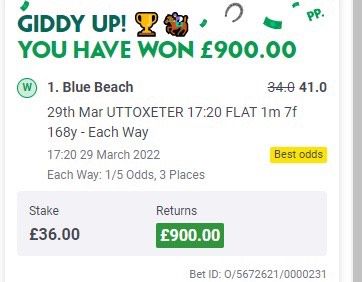
My promise.
Look, I can't guarantee every tip every day is going to win (anyone that can is a fraudster). But I can promise you that every horse I will tip I am betting on myself and through my data analysis techniques it should be in with a very strong chance of bolting up and winning and over a long enough period you will be profitable.
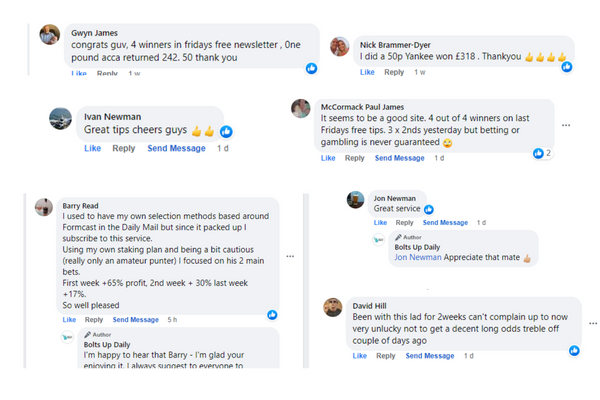
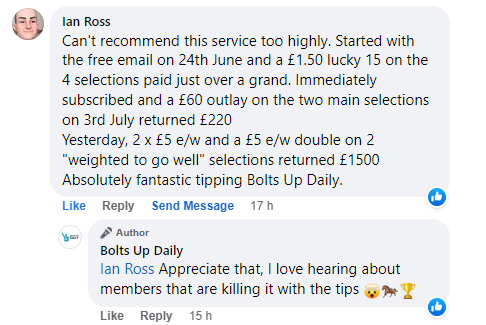
Here's what some of our paid members have been saying:
Give it a go, what have you got to lose? It's only a tenner a month. Feel free to try out the free version first!
- The Guv'nor
Where to go next: the strategy guides
Prices and the market
Value betting in horse racing is the deep end of Rule 2: overround, closing line value, the favourite-longshot bias and how I spot an overpriced horse.
How often do favourites win? is the full UK and Irish study, split by race type, field size and course.
Stakes and banks
Staking plans for horse racing puts level stakes, percentage-of-bank and Kelly through simulations of drawdowns and losing runs.
What does 1pt mean in betting? covers points, betting banks and the each-way trap where 1pt each-way actually costs 2pts.
Systems, tipsters and AI
Horse racing betting systems that work? back-tests the popular ones on Betfair data, and shows how a small sample fools people.
Are horse racing tipsters worth it? is my honest answer, with how to judge one.
AI horse racing predictions asks whether ChatGPT and AI tipping tools can pick winners, with an ex-quant's verdict.
The professional end
Why bookies restrict winning accounts explains gubbing and stake factoring from someone the bookies have knocked back.
Can you make a living betting on horses? runs the turnover maths and covers tax on winnings in the UK and Ireland.
Brand new to betting? Start with how to bet on horse racing for bet types and placing your first bet.
Horse racing betting strategy FAQs
What is the best way to bet on horse racing?
Back horses whose price is bigger than their true chance, stake in points from a set bank, and take early prices with Best Odds Guaranteed where you can. Keep multiples for bets you'd happily have as singles.
How do you win at horse racing betting?
By finding prices that are bigger than they should be, over enough bets. Nobody wins every day, and anyone who guarantees winners is a fraudster. Long-term winners have an edge they can explain, staking that survives the losing runs and records that prove it.
How do I get good at horse betting?
Specialise in one area and record every bet with the price you took and the Betfair SP. If your prices regularly beat the BSP, you're on the right track even before the profit shows.
Is there a horse racing betting strategy that always wins?
No. Even with a genuine +10% edge at 4/1, there's more than a one-in-three chance you're level or behind after 100 bets, as the table in Rule 4 shows.
Is horse racing betting strategy different in the UK?
The principles are the same anywhere, but a horse racing betting strategy in the UK should use the tools UK and Irish punters have: early prices with Best Odds Guaranteed, each-way terms and the Betfair exchange with its BSP. That's why Rule 7 exists.
Other guides
- How to bet on horse racing: the beginner's guide
- How to read horse racing form
- Big races calendar and previews
- Irish horse racing tips
- UK and Irish racecourse guides
- How my premium tips work
I run Bolts Up Daily. I was a Quantitative Researcher at a Tier 1 Investment Bank (essentially a statistics and maths geek), and I now use those skills to analyse UK and Irish racing, profitably enough that most of your favourite bookies won't take a bet from me. Every horse I tip, I'm betting on myself, and every bet comes with a stake in points. I own racehorses too. Look, I can't guarantee every tip is going to win (anyone that can is a fraudster), but I care about profit, not strike rate.
More from The Guv'nor · How my tips service works