
Home › How to Bet › Lucky 15 Explained
By The Guv'nor · Last updated October 2026
Lucky 15 explained in one breath: it's 15 bets on four horses in four different races, made up of four singles, six doubles, four trebles and one four-fold accumulator. One winner is enough to get something back. A £1 Lucky 15 costs £15, or £30 each-way. Pop your four prices into the calculator below to see what comes back.
If you're after the horses rather than the maths, that's what my lucky 15 tips page is for, and if betting is new to you altogether, start with my beginner's guide to how to bet on horse racing. This one is the how-it-works bit, written by a self-confessed statistics/maths geek, so expect a few numbers.
Lucky 15 calculator: work out your returns
It does win-only or each-way: type each horse's odds (fractional like 5/1 or decimal like 6.0), pick what happened, and add any bonus your bookie pays.
| Winners | Which ones won | Returns | Profit or loss | With double-odds and 10% bonuses |
|---|---|---|---|---|
| 0 | None | £0.00 | -£15.00 | £0.00 |
| 1 | The 2/1 shot | £3.00 | -£12.00 | £5.00 |
| 1 | The 5/1 shot | £6.00 | -£9.00 | £11.00 |
| 2 | 2/1 and 3/1 | £19.00 | +£4.00 | £19.00 |
| 3 | 2/1, 3/1 and 4/1 | £119.00 | +£104.00 | £119.00 |
| 4 | All four | £839.00 | +£824.00 | £921.40 |
The last column assumes a bookie paying double the odds on a lone winner and 10% on top of the winnings when all four win. More on what those bonuses are really worth further down.
What is a Lucky 15 bet? The 15 bets in one table
So how does a Lucky 15 work? Call your four horses A, B, C and D. A Lucky 15 is every possible combination of them, which is why it's known as a "full cover" bet with singles. Take the four singles out and you've got a Yankee, which is 11 bets.
| Bet type | How many | The lines | What has to win |
|---|---|---|---|
| Singles | 4 | A, B, C, D | That one horse |
| Doubles | 6 | AB, AC, AD, BC, BD, CD | Both horses |
| Trebles | 4 | ABC, ABD, ACD, BCD | All three |
| Four-fold | 1 | ABCD | All four |
Your stake is per line, so "£1 Lucky 15" means £1 on each of the 15 bets. The same goes in euro: a €1 Lucky 15 is €15. The four horses have to be in different races, because the doubles and trebles need separate events to multiply together.
How to place a Lucky 15 bet
- Add your four selections to the betslip, one from each of four different races.
- Look in the multiples section and find "Lucky 15".
- Put your stake in that box. It's the stake per line, so check the total says 15 times it.
- Tick each-way if you want it, and the total doubles to 30 bets.
Worked example: returns with one, two, three or four winners
Here's where the numbers in the calculator table come from. Same four horses at 2/1, 3/1, 4/1 and 5/1, £1 a line. The trick is to think in returns, not winnings: a £1 winner at 2/1 gives you £3 back, so that horse multiplies whatever is on it by 3.
- One winner (the 2/1): only its single pays. £3 back from £15. Every double, treble and the four-fold has a loser in it.
- Two winners (2/1 and 3/1): two singles (£3 + £4) plus the double, where £1 at 2/1 makes £3 and that £3 rolls on at 3/1 to make £12. Total £19.
- Three winners (2/1, 3/1, 4/1): three singles (£12), three doubles (£12 + £15 + £20 = £47) and the treble (3 x 4 x 5 = £60). Total £119.
- Four winners: all 15 lines land. There's a shortcut: multiply each horse's "odds plus one" together and take one off, so 4 x 5 x 6 x 7 = 840, minus 1 = £839.
That shortcut is the whole Lucky 15 in one sum, and it's how the calculator works. Two winners scrape a small profit at these prices, three is a proper touch, and four is where the silly numbers live.
Each-way Lucky 15 explained: 30 bets, place terms and cost
An each-way Lucky 15 is two Lucky 15s stuck together: one on the horses to win and one on them to place. That's 30 bets, so a £1 each-way Lucky 15 costs £30 (50p each-way is £15). The two halves are settled separately, win to win and place to place.
The place half pays a fraction of the odds. Unless your bookie shows something different, the standard terms from the Tattersalls Committee Rules on Betting (Rule 3) are:
- Fewer than 5 runners: all to win (the place stake goes on to win).
- 5 to 7 runners: 1/4 odds, places 1-2.
- 8 or more runners: 1/5 odds, places 1-2-3.
- Handicaps with 12 to 15 runners: 1/4 odds, places 1-2-3.
- Handicaps with 16 or more runners: 1/4 odds, places 1-2-3-4.
Same four horses, £1 each-way (£30 total), all on 1/5 odds a place:
| What happened | Win part | Place part | Total back | Profit or loss |
|---|---|---|---|---|
| Only the 5/1 shot places | £0.00 | £2.00 | £2.00 | -£28.00 |
| 3/1, 4/1 and 5/1 all place | £0.00 | £20.84 | £20.84 | -£9.16 |
| All four place, none win | £0.00 | £51.42 | £51.42 | +£21.42 |
| 2/1 wins, other three place | £3.00 | £51.42 | £54.42 | +£24.42 |
| All four win | £839.00 | £51.42 | £890.42 | +£860.42 |
Look at that middle row. Three of your four horses hit the frame and you're still nearly a tenner down, because a place at 1/5 of 3/1 only multiplies your money by 1.6. On short prices an each-way Lucky 15 can feel like a great day and still lose money; it makes far more sense on bigger prices. The full each-way maths is in my guide to each-way betting explained.
Bonuses and consolations: what they're really worth
The "Lucky" in the name comes from bookies paying bonuses on these bets. The common ones are a consolation of double (sometimes treble) the odds if only one of your four wins, and a bonus of around 10% on your winnings if all four win. Terms differ between bookies and change, and they usually apply to the win part of an each-way bet only, so read your own bookie's offer before counting on it.
So what are they worth? I've taken four horses at the same price and assumed each gives back 90p for every £1 staked over the long run (that's the bookie's margin), then worked out the expected return on the whole Lucky 15 with and without a double-odds consolation and a 10% four-winner bonus.
| Price of each horse | Chance each wins | Chance of exactly one winner | Lucky 15, no bonus | With double odds + 10% |
|---|---|---|---|---|
| 6/4 | 36.0% | 37.7% | -19.8% | -14.5% |
| 3/1 | 22.5% | 41.9% | -19.8% | -10.4% |
| 5/1 | 15.0% | 36.8% | -19.8% | -6.7% |
| 8/1 | 10.0% | 29.2% | -19.8% | -3.6% |
| 12/1 | 6.9% | 22.3% | -19.8% | -1.3% |
Two things jump out. First, nearly all of the bonus value comes from the one-winner consolation, not the headline all-four bonus: four winners is so unlikely that the 10% is worth between 0.6% and 1.5% of your stake across these rows. Second, the consolation is worth much more on bigger prices, because doubling the odds of a 12/1 winner adds £12 to a £1 single where doubling a 6/4 winner adds £1.50. On the same assumptions a treble-odds consolation pushes the 5/1 row to +5.6%.
Don't take that as "bonuses beat the bookies". Longer-priced horses often give back less than 90p in the pound in the first place (the favourite-longshot bias), so the real numbers depend on the prices you actually get. What it does tell you is that if you're having a Lucky 15 anyway, take it with the bookie paying the best one-winner consolation.
Non-runners and dead heats in a Lucky 15
Non-runners
If one horse doesn't run, all 15 bets still stand. The non-runner's single is refunded and every multiple with it in drops down a level: a double with the non-runner in it becomes a single on the other horse, a treble becomes a double, and the four-fold becomes a treble on the three that ran. So with D out and A, B and C all winning at 2/1, 3/1 and 4/1, you'd get back £239 from £15, not £839.
If a horse is withdrawn from one of your races after you've taken a price, the bookie can take a deduction off your winnings on that leg. That's Rule 4, and the full official table is on my Rule 4 deductions page. The calculator lets you add a deduction for each horse.
Dead heats
Under Tattersalls Rule 10, a dead heat for first halves your stake on that horse and pays full odds on the other half. In a multiple, the halved stake times the odds becomes the stake that rolls on. Using the example horses, if the 2/1 shot dead-heats and the 3/1 shot wins, the double pays £6 rather than £12: 50p at 2/1 is £1.50, which then goes on at 3/1.
Lucky 15 vs Yankee vs four singles: the margin maths
This is the bit that matters most. Every bookie price has a margin built in. Say each of your horses returns 90p per £1 over time (a 10% bookie edge, picked to keep the maths round). A single loses you 10%. A double has the margin applied twice, so it returns 0.9 x 0.9 = 81p. A treble returns 73p and a four-fold 66p. Multiples compound the margin.
It works the other way too. If you're genuinely good at this and your horses return £1.10 per £1, a four-fold returns about £1.46. Multiples magnify whatever edge you have, good or bad.
| Each horse returns per £1 | Four singles | Lucky 15 (15 bets) | Yankee (11 bets) |
|---|---|---|---|
| 85p | -15.0% | -28.6% | -33.5% |
| 90p | -10.0% | -19.8% | -23.3% |
| 95p | -5.0% | -10.3% | -12.2% |
| £1.00 | 0.0% | 0.0% | 0.0% |
| £1.05 | +5.0% | +11.1% | +13.3% |
| £1.10 | +10.0% | +23.0% | +27.7% |
If you want to check me, it's the same shortcut as the worked example: at 90p a horse, (1.9 x 1.9 x 1.9 x 1.9 - 1) / 15 = 0.80, so about 80p in the pound.
So the difference between a Yankee and a Lucky 15 isn't just that the Lucky 15 pays on one winner while the Yankee needs two. The four singles dilute the multiples, so a Lucky 15 hurts less than a Yankee when your horses are poor value and pays less when they're good value. Trixies, Patents and the bigger full cover bets are in Yankee bet explained.
Is a Lucky 15 a good bet?
It's a good bet when your four horses are value and a bad one when they aren't. Like I said, the bet itself doesn't change the maths, it magnifies it. Four horses at prices that are too short turn a 10% loss into a 20% loss. Four horses at bigger prices than they should be turn a small edge into a big one.
How I think about them
Look, I used to be a Quantitative Researcher at a Tier 1 investment bank. I'm essentially a statistics/maths geek, so I'll always tell you the price matters more than the bet type. I don't judge a bet on how often it wins, I judge it on profit month to month. A Lucky 15 full of odds-on jollies will give you plenty of small returns and still lose you money. I'd rather have outsiders with an each-way chance, because even when they only place we can make more than an odds-on shot winning.
The other thing is staking. The whole bet is your stake, not the £1 on each line. If you work in points and 1pt is £5 on a £100 bank, a £1 Lucky 15 is £15, so that's 3pts riding on four horses (if points are new to you, here's what 1pt means in betting). Don't go doubling it because you've got a feeling about one of them, and don't chase yesterday's losers with a bigger one today. If you're unsure about one of the four, skip the bet. Lucky 15s lose more often than they win, and understanding that losers are a thing is the key to being a winner longer term. Every horse I put in my tips service I'm betting on myself. The bigger picture on bankrolls and edges is in my horse racing betting strategy guide.
Now you know how it works, want the horses to put in it?
Price
Price of the service is a fixed £9.99 monthly and that will never change and you can cancel anytime if it's not for you. To break that down for you that's about 32p a day for a whole month or a going to have a McDonalds with a mate. Crazy right?
I've priced it cheap because I want it accessible to absolutely everyone and build a community of winners - If I am honest the £9.99 is just there as a filter if you like so that only serious people sign up. If the paid version isn't for you just yet, then feel free to sign up to the free service.
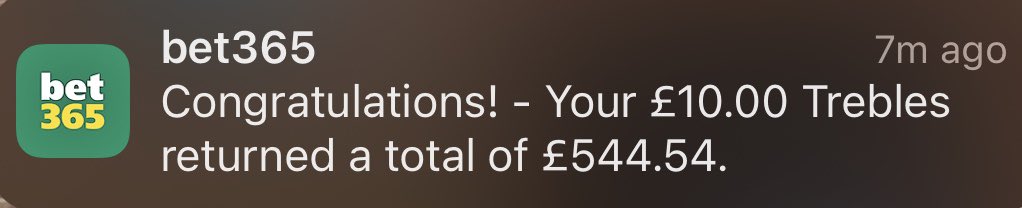
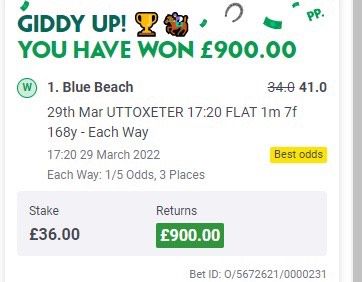
My promise.
Look, I can't guarantee every tip every day is going to win (anyone that can is a fraudster). But I can promise you that every horse I will tip I am betting on myself and through my data analysis techniques it should be in with a very strong chance of bolting up and winning and over a long enough period you will be profitable.
Here's what some of our paid members have been saying:
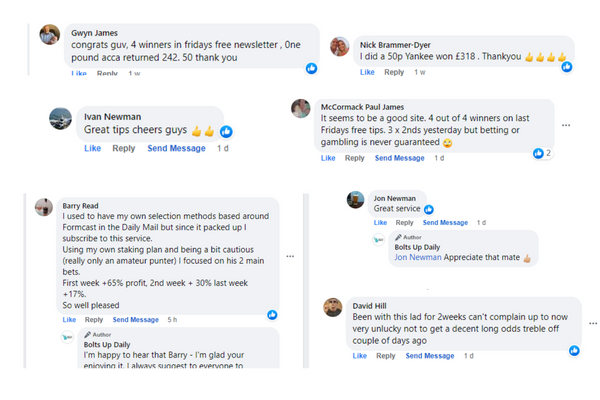
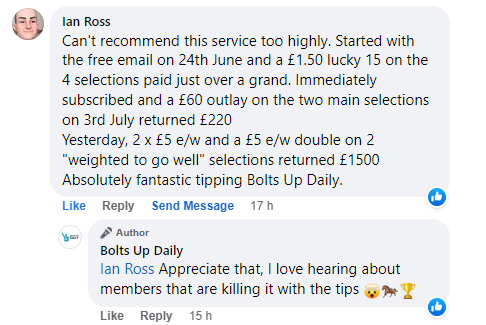
Give it a go, what have you got to lose? It's only a tenner a month. Feel free to try out the free version first!
- The Guv'nor
Lucky 15 FAQs
How many horses do you need for a Lucky 15?
Four, each in a different race. With three horses the equivalent bet is a Patent (7 bets), and with five it's a Lucky 31 (31 bets).
Why is it called a Lucky 15?
The 15 is the number of bets. The "Lucky" comes from the bonuses bookies attach to it, most often double the odds if only one horse wins.
Can you have two horses from the same race in a Lucky 15?
No. Bookies define a Lucky 15 as four selections in different events, because the doubles, trebles and four-fold need separate races to combine.
How much does a 50p each-way Lucky 15 cost?
£15. That's 50p on 15 win bets plus 50p on 15 place bets, 30 bets in all. A 50p win-only Lucky 15 is £7.50.
What's the difference between a Lucky 15 and a Lucky 31?
A Lucky 31 uses five horses: 5 singles, 10 doubles, 10 trebles, 5 four-folds and a five-fold. It costs 31 stakes, and the margin compounds even harder across five-horse multiples.
More in this guide
- How to bet on horse racing: the beginner's guide
- Yankee, Trixie, Patent and Heinz bets explained
- Each-way betting and place terms
- The Rule 4 deductions table
- Horse racing odds explained
- Betting terms from A to Z
I run Bolts Up Daily. I was a Quantitative Researcher at a Tier 1 Investment Bank (essentially a statistics and maths geek), and I now use those skills to analyse UK and Irish racing, profitably enough that most of your favourite bookies won't take a bet from me. Every horse I tip, I'm betting on myself, and every bet comes with a stake in points. I own racehorses too. Look, I can't guarantee every tip is going to win (anyone that can is a fraudster), but I care about profit, not strike rate.
More from The Guv'nor · How my tips service works